
robot-beingbeyond-d1
robonix.robot.beingbeyond.d1 — Robonix whole-robot deployment for the BeingBeyond
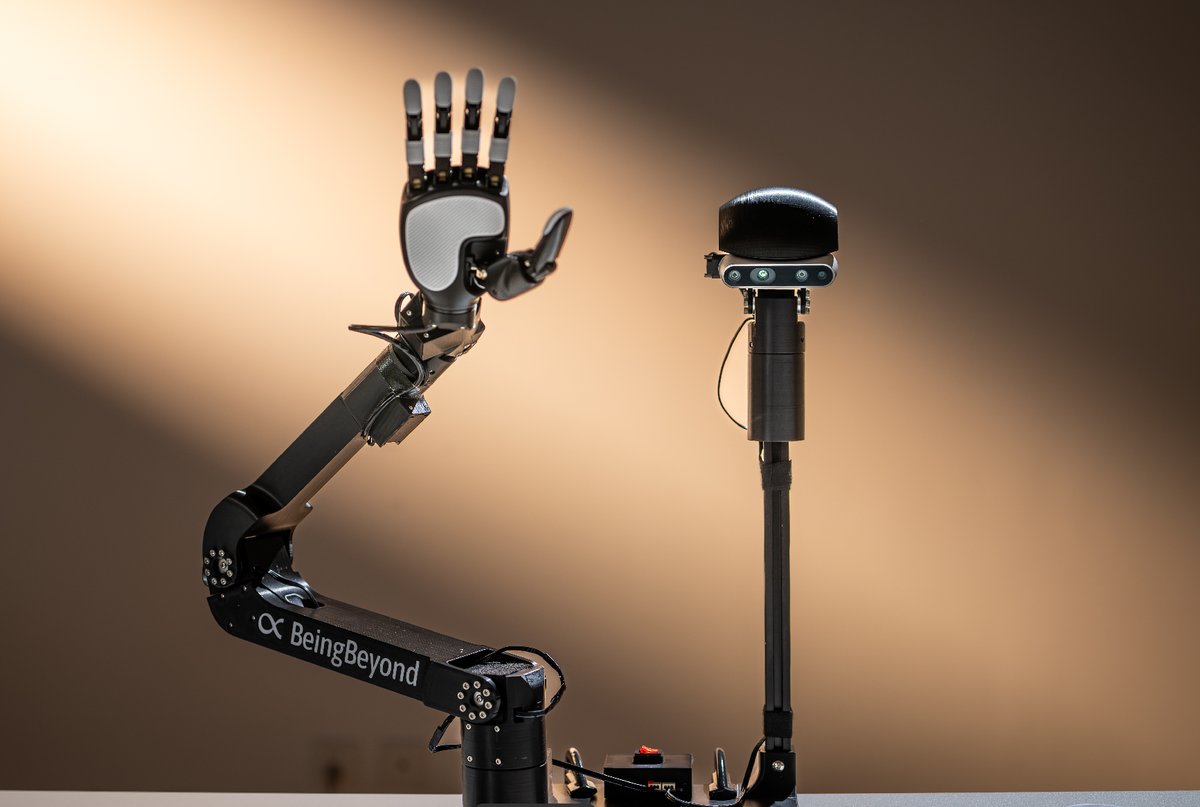
D1 desktop robot: a fixed-base 6-DOF arm, a 2-DOF head pan/tilt, a five-finger
dexterous hand, and a head RGB-D camera.
The centrepiece is the object pick-and-place skill (vertical_grasp_object,
8 MCP tools), plus a hand_gesture skill. Both are driven through pilot, either
from rbnx chat (text) or over the voice pipeline.
Capabilities
| Tool | What it does |
|---|---|
detect_objects(instruction) |
Open-vocabulary VLM detection from a natural-language description (colour / shape / text / spatial relation). Returns a base-frame grasp point and grasp yaw. Preferred in general |
detect_cubes(class_filter) |
YOLO-OBB detection of coloured cubes (red/blue/green/yellow), same schema. Preferred for cubes, and the fallback when no VLM is configured |
pick_cube(position, angle_deg, gripper) |
Move to a position, grasp at the given yaw / tightness, keep holding |
place_cube(position, angle_deg, gripper) |
Move to a position and release; z sets the stacking height. Parks out of the camera's view on success |
stack_cubes(top_color, base_color, gripper) |
One call for "stack A on B": detect → pick → place. Preferred for stacking |
put_cube_in_container(color, gripper) |
One call to drop a cube of the given colour into the fixed container spot |
sort_cubes(gripper) |
One call to sort every cube on the table into its colour's fixed spot |
verify_grasp(instruction, mode, position) |
VLM re-check of whether a pick / place landed — the basis for closed-loop retries |
gesture_dance(duration_s) |
Make the dexterous hand dance, then leave it open |
position is base-frame metres as "x,y" / "x,y,z", or a named location. Both
ASCII and full-width commas are accepted. Detection geometry runs through the
hand-eye homography plus a perspective correction; depth is the fixed table Z
(neither detector uses the RealSense depth stream).
Platform and hardware inventory
Compute platform: x86_64, WSL2 / Ubuntu 22.04 on a Windows 11 host, native
(not containerised). No ROS 2 — every primitive talks to the vendor SDK
directly and serves its capabilities over gRPC, so no topic_out streaming
contracts are provided. Python 3.10 (conda env bb_d1_robonix). Verified against
Robonix commit 8c0baca2e9f95c334b9ef078419c7bd20739bac7 (2026-07-20).
Hardware and connections:
| Device | Model | Connection |
|---|---|---|
| Arm + head pan/tilt | BeingBeyond D1 (6 + 2 DOF) | serial /dev/ttyUSB0 @ 1000000 (arm and head share this one port) |
| Dexterous hand | Linker five-finger, six-axis | CAN can0 @ 1000000 |
| Head camera | Intel RealSense D435i | USB 3.0, 1280x720@30 |
| Mic / speaker | Windows host devices | via WSLg's PulseAudio pulse device |
Frames: one whole-robot URDF (urdf/robot_right_hand.urdf), root link
link_base, with the arm chain and the head chain branching off it and the camera
frame named camera; every fixed transform lives in that tree. Fixed-base
deployment with no ROS 2, so there is no TF publisher — the pixel→base
transform is done by the hand-eye homography inside the skill, and
handeye_calib.npz is the single source of truth for that chain.
Safety boundaries:
- There is no software e-stop. Only hardware power-off / a physical e-stop. Verify the hardware e-stop independently halts arm and hand before any motion.
- Joint limits come from the controller firmware and the URDF.
move_poseonly commands a pose when IK converges withinik_pos_tol(default 0.05 m), otherwise it errors without moving. - Bus permissions: serial needs
chmod 666 /dev/ttyUSB0ordialoutmembership; CAN is brought up by DexHand at init (when not root, bring the interface up beforehand or exportPREFLIGHT_SUDO_PASS). - Watchdog: every provider stops hardware output and releases the serial link on
input timeout, process exit, or
CMD_SHUTDOWN. - A
pick_zset too low presses the fingers into the table. For the hand's first open/close, lower the torque ceiling withset_joint_torque_limits. The skill does no collision checking. - The footprint in
soma.yamlis the base mounting outline only (0.20 m square), not a drivable area; the arm's dynamic envelope is not in a static footprint.
Deployment composition
| Kind | Instance | Package | Source |
|---|---|---|---|
| primitive | d1_arm |
robonix.primitive.beingbeyond.d1.arm |
primitive-beingbeyond-d1-arm-rbnx |
| primitive | d1_hand |
robonix.primitive.beingbeyond.d1.hand |
primitive-beingbeyond-d1-hand-rbnx |
| primitive | d1_camera |
robonix.primitive.beingbeyond.d1.camera |
primitive-beingbeyond-d1-camera-rbnx |
| primitive | audio_driver |
robonix.primitive.audio.alsa |
primitive-audio-driver-rbnx |
| service | speech |
— | ${ROBONIX_SOURCE_PATH}/services/speech (built into robonix) |
| skill | vertical_grasp_object |
robonix.skill.vertical_grasp_object |
skill-vertical-grasp-object-rbnx |
| skill | hand_gesture |
robonix.skill.hand_gesture |
skill-hand-gesture-rbnx |
This repo does assembly and robot-specific config only: the manifest,
soma/urdf, offline tools, and the detection assets. Every driver and skill lives
in its own repository and is fetched by the manifest's url: + branch: into
rbnx-boot/cache/<repo-name>/. Each package's capability table, config fields,
and safety notes are in its own README.
Changing package code therefore means: edit in the package repo → push → here run
rbnx clean -f robonix_manifest.yaml --cache → rbnx build again.
Layout
robot-beingbeyond-d1/
├── robonix_manifest.yaml   # deployment manifest: system components + voice + 4 primitives + speech + 2 skills
├── soma.yaml               # D1 body model (urdf.path → ./urdf/)
├── .env.example            # VLM + Tencent Cloud TTS credential template (copy to .env)
├── assets/robot.jpg        # catalog preview image, also used by tools/func_verify/
├── models/                 # detection assets: best.pt + handeye_calib.npz (robot-specific, git-ignored)
├── urdf/
│   ├── robot_right_hand.urdf   # whole-robot URDF (for soma / IK), root link = link_base
│   └── meshes/                 # STLs referenced by the URDF (incl. right_hand/)
└── tools/                  # offline tools, not part of the deployment
    ├── func_verify/        # D1 SDK self-check samples (separate env bb_d1_rbnx, see its README)
    ├── yolo_train/         # cube-detection labelling + training chain; copy best.pt into models/
    ├── arm_calibration/    # hand-eye calibration / sag compensation; produces handeye_calib.npz
    └── vision.py           # RealSense capture helper
The skills are pure robonix consumers: on_activate discovers the primitives
through atlas and drives them over their gRPC contracts; they never open the
serial link / CAN bus / RealSense themselves. IK/FK, YOLO, and the hand-eye
projection are local pure compute.
Voice
rbnx boot brings up the voice pipeline: audio_driver (under WSLg the mic and
speaker go through the PulseAudio pulse device — WSLg has no real sound card, so
arecord -l is empty and the device MUST be set explicitly to pulse) plus the
speech service.
- ASR: the
custombackend forwards 16k/mono/pcm_s16le to an external PaddleSpeech streaming WebSocket (PADDLE_ASR_PORT=8090; leaving the host unset resolves to the WSL gateway = the Windows host, so a WSL restart changing the IP does not matter). - TTS: Tencent Cloud TextToVoice (
voice_type=1001, the basic zhiyu voice), returning 16 kHz mono pcm_s16le that the speaker primitive plays directly. ExportTENCENTCLOUD_SECRET_ID/_SECRET_KEYin the operator shell.
Picking the custom backend also keeps rbnx build from pulling in
Torch/CUDA/FunASR/Whisper.
Deploy and run
Prerequisites: a Python 3.10 env bb_d1_robonix (ultralytics + the robonix/mcp
deps, plus
pip install tools/func_verify/lib/beingbeyond_d1_sdk-0.2.0-cp310-*.whl — the
wheel ships in this repo and is cp310 + manylinux_2_17_x86_64, so the env has
to be Python 3.10 / x86_64); the d1_arm / d1_hand / d1_camera hardware
connected with bus permissions in place; the YOLO weights and hand-eye calibration
in ./models/ (best.pt + handeye_calib.npz, see that dir's README), and
D1_DEPLOY_DIR in the manifest's env: pointing at this repo's real path. For
voice, start the external PaddleSpeech ASR service first.
cp .env.example .env && $EDITOR .env    # VLM endpoint + Tencent Cloud TTS credentials
set -a && . ./.env && set +a            # export into the shell (the manifest expands ${VAR})
rbnx setup "$PWD"                       # register ${ROBONIX_SOURCE_PATH}
rbnx build -f robonix_manifest.yaml     # fetch the url: packages, then codegen each (--mcp for skills)
rbnx boot -v -f robonix_manifest.yaml   # foreground; logs go to rbnx-boot/logs/
Acceptance, from a second terminal:
rbnx caps -v          # 4 primitives + speech ACTIVE; the 2 skills INACTIVE (expected)
rbnx logs -d ./rbnx-boot/logs -l warn
rbnx chat             # e.g. "stack the red cube on the blue one" / "sort the cubes by colour"
rbnx shutdown -f robonix_manifest.yaml
Skill-kind packages staying INACTIVE is per spec — the executor fires
CMD_ACTIVATE on the first MCP call. The rbnx build summary should read
Failed: 0 / Skipped: 0 with Built equal to the manifest's instance count (7).
Do not start from motion on a new robot: run the read-only paths first
(d1_camera snapshot, arm/get_state, detect_objects / detect_cubes), confirm
the returned coordinates, timestamps, and frames look right, then add the motion
instances back one at a time to verify single joints, finger open/close, and the
e-stop.
Notes
- Grasp height
pick_z, cube heightblock_height,table_z_offset, asset paths, the VLM endpoint,grasp_feedbackand friends are tuned in the skill'sconfig:block inrobonix_manifest.yaml. Field semantics live in each package'sconfig.spec; call semantics in the skills'CAPABILITY.md. detect_objects/verify_graspneed an OpenAI-compatible VLM endpoint (VLM_BASE_URL/VLM_API_KEY/VLM_MODEL). Without it those two tools are unavailable and the other six keep working.- The hand-eye calibration is tied to the camera mount and the table height — re-calibrate if the head camera is remounted or the table height changes.
- Everything under
tools/is offline and takes no part inrbnx boot.tools/func_verify/uses its own envbb_d1_rbnxto talk to the SDK directly for hardware self-checks, independent of thebb_d1_robonixdeployment env.
License
MulanPSL-2.0